

How to Choose the Right Water Filter for Your Caravan
Not sure which water filter suits your caravan? We break down portable, refillable and built-in options, plus the hoses and tank products that keep your water fresh on the road.
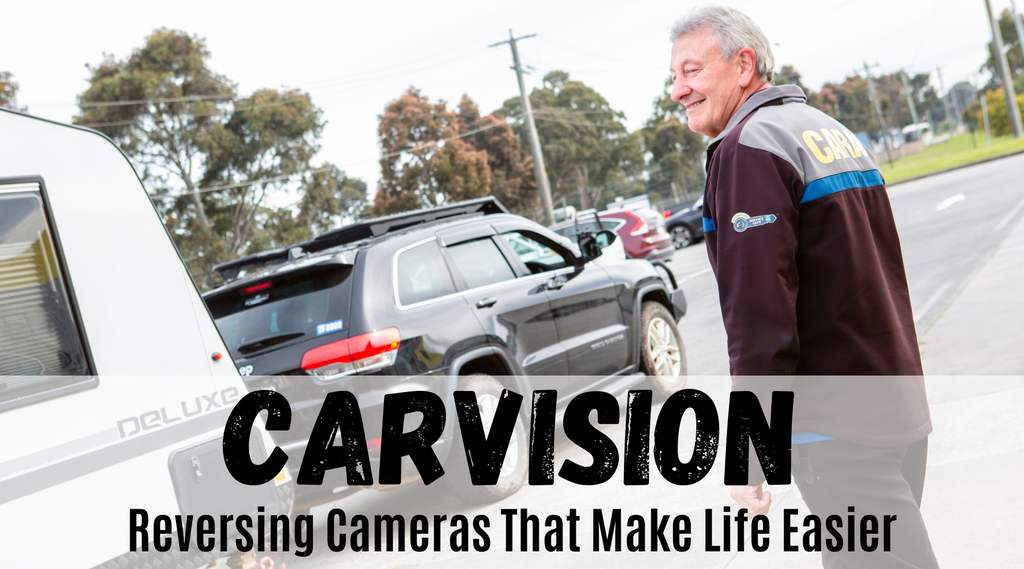
Reversing a caravan is often called the Everest of caravanning, and it can turn a relaxing trip into a stressful ordeal, especially when the whole campground is watching and offering unsolicited advice. A good wireless reversing camera removes the guesswork, the hand signals and the arguments. This guide explains how the Carvision digital wireless range works, breaks down the full specifications of each model, compares Carvision against other popular brands, and helps you choose the right kit for your rig.
If you are still deciding whether a reversing camera is worth it, below are the main reasons caravanners tell us they want to fit one.
Rear visibility has become so central to road safety that reversing cameras and rear parking sensors are being mandated on new vehicles in Australia. Fitting one to your caravan simply extends that same protection to the longest, hardest-to-see part of your setup.
Carvision offers a range of wireless reversing cameras that make reversing anxiety a thing of the past. The camera mounts at the rear of your caravan and connects to the park or reverse light, so it activates automatically. The monitor suction-mounts to your windscreen, or straps over your rear-view mirror with the supplied U-bracket, and simply plugs into your 12V accessory socket. There is no wiring to run through the tow vehicle and only minimal wiring at the caravan, which keeps fitment quick and affordable.
This is the most important difference between Carvision and many budget kits, and it is worth understanding. Cheaper wireless cameras often use an analogue 2.4GHz signal, which is prone to interference from other devices on the same band, such as Wi-Fi networks, Bluetooth and even other vehicles' wireless cameras.
That interference shows up as static, snow or a flickering picture, and it is the single most common complaint in reviews of low-cost systems. There are even reports of owners picking up the camera feed from a vehicle in front.
Carvision instead uses an advanced digital 2.4GHz signal that resists this interference and delivers a clean, stable image with hardly any delay. In plain terms: analogue can pick up noise from other devices, while digital largely ignores it. For reversing, where you need the picture to be there instantly and reliably, that difference matters.
The standard CV-SQWRLS camera is a Full HD 1080p unit with a 2.0 megapixel, 1/2.7 inch sensor and a 120 degree viewing angle. That angle is the recognised sweet spot for reversing: wide enough to see obstacles to the sides of the van, without the distortion of ultra-wide lenses that make objects look further away than they really are.
Full HD resolution means kerbs, bollards and tow balls are easy to judge, a clear step up from the 640 x 480 standard-definition sensors still found in many entry-level kits.
The camera uses 11 infrared LEDs with a Smart IR-Cut filter that switches automatically between 650nm for day and 850nm for night. This gives a clear black-and-white picture after dark for safe reversing into unlit sites. Automatic day and night switching is a genuine quality marker, not something every budget camera includes.
A rear caravan camera lives in dust, rain and road spray, so its ingress-protection rating matters. Both Carvision cameras carry an IP69 rating, the top of the scale for dust and high-pressure, high-temperature water jets, and higher than the IP65 rating quoted by several imported rivals. The lens is also coated to resist water, oil and fog, so it stays clear in the wet.
The 5 inch monitor runs at 1000 CD/m2 and the 7 inch at 900 CD/m2, both bright enough to read in direct Australian daylight. The 5 inch supports up to two cameras in single or split-screen; the 7 inch supports up to four cameras in single, split or quad view. That lets you combine a wide reversing view with side, hitch or interior views on one screen.
Each digital monitor has a built-in DVR that records your journey or any incident to a microSD (TF) card, from 8GB up to 128GB. It is useful for reviewing a manoeuvre or as evidence after a collision.
Because there is no tow-vehicle wiring and only minimal caravan wiring, powered from any 12V to 24V source such as the reverse or park light, the whole project stays budget-friendly. We also provide on-site fitment by our auto electrician in the Carac workshop.
There are three kits in the Carvision range. All use the same digital 2.4GHz technology and the same Full HD CV-SQWRLS camera; the differences are screen size, how many cameras you can run, and transmission distance.
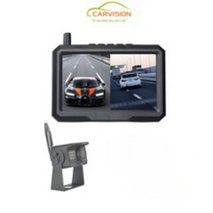
5" Kit, 1 Camera
$449.00
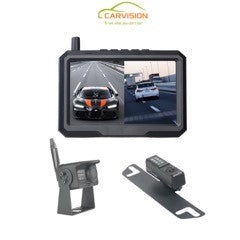
5" Kit, 2 Camera
$529.00
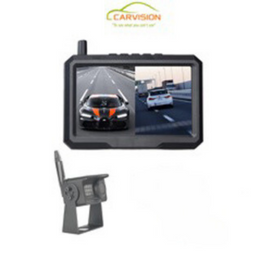
7" Kit
$549.00
| Specification | 5" Kit, 1 Camera | 5" Kit, 2 Camera | 7" Kit |
|---|---|---|---|
| Price | $449.00 | $529.00 | $549.00 |
| Part number | CV-5WRLS | CV-5WRLS | CV-7WRLS |
| Monitor | 5" colour digital LED, 800 x 480 | 5" colour digital LED, 800 x 480 | 7" colour digital LED, 1024 x 600 |
| Brightness | 1000 CD/m2 | 1000 CD/m2 | 900 CD/m2 |
| Cameras included | 1 (CV-SQWRLS) | 2 (CV-SQWRLS & CV-NPWRLS) | 1 (CV-SQWRLS) |
| Maximum cameras | 2 | 2 | 4 |
| Screen modes | Single or split | Single or split | Single, split or quad |
| Camera resolution | 1080p Full HD | 1080p Full HD | 1080p Full HD |
| Viewing angle | 120 degrees | 120 degrees | 120 degrees |
| Transmission distance | 299m line of sight | 299m line of sight | 502m line of sight |
| Night vision | 11 IR LEDs, auto day/night | 11 IR LEDs, auto day/night | 11 IR LEDs, auto day/night |
| Weatherproofing | IP69 | IP69 | IP69 |
| Built-in DVR | Yes, microSD 8 to 128GB | Yes, microSD 8 to 128GB | Yes, microSD 8 to 128GB |
| Power | DC 12V to 24V, 6W | DC 12V to 24V, 6W | DC 12V to 24V, 6W |
| Mounting | Suction or mirror bracket | Suction or mirror bracket | Suction or mirror bracket |
Special note on the 5" Kit, 2 Camera: The second camera included in this kit is Carvision's CV-NPWRLS, a number-plate style camera. Unlike the standard rear camera, it mounts near your number plate and has no visible housing, giving you a more discreet look.
Shoppers researching wireless caravan cameras usually weigh up Carvision against imported brands such as Furrion and Haloview, as well as generic 2.4GHz kits. Here is how the key features line up. Competitor figures are the manufacturers' stated specifications and indicative pricing, and wireless range quoted by overseas brands is a line-of-sight figure that will be shorter in real conditions.
| Feature | Carvision (Carac) | Furrion Vision S+ | Haloview MC/RD | Generic 2.4GHz kit |
|---|---|---|---|---|
| Signal type | Digital 2.4GHz | Digital 2.4GHz | Digital 2.4GHz | Often analogue 2.4GHz |
| Camera resolution | 1080p Full HD | 1080p | 720p | Often 640 x 480 |
| Monitor sizes | 5" and 7" | 5", 7" | 7" and larger | 3.5" to 7" |
| Cameras supported | Up to 2 (5"), up to 4 (7") | Up to 4 | Up to 4 | 1 to 2 |
| Built-in DVR | Yes, 8 to 128GB | SD card recording, card not included | Yes | Rarely |
| Night vision | 11 IR LEDs, auto day/night | IR with cut filter | IR | Basic |
| Viewing angle | 120 deg (160 deg plate cam) | 140 deg rear | Wide angle | Varies |
| Weatherproofing | IP69 | IP65 | IP69K on many | Often unrated |
| Stated range | 299m to 502m line of sight | ~30m driving | ~300m marketing figure | Short, interference prone |
| Local fitment and support | Yes, Carac workshop in Victoria | Distributor | Online | DIY |
| Indicative price | $449 to $549 | ~$400 to $900+ | ~$300 to $800+ | ~$100 to $250 |
The takeaway: Carvision matches the premium imported brands on the things that matter, digital 2.4GHz, Full HD, multiple cameras, split screen and a built-in DVR, while adding two things the imports usually cannot. You get an IP69 camera and automatic day and night vision, plus local Victorian support and professional in-house fitment.
Choose the 5 inch, 1 camera kit if you want a straightforward single rear view for reversing and towing, at the best price.
Choose the 5 inch, 2 camera kit if you want a rear reversing view plus a second view, for example a number-plate camera for discreet mounting or a second angle, shown side by side in split screen.
Choose the 7 inch kit if you have a larger rig, want the biggest screen, need the longer 502m transmission distance, or plan to run up to four cameras such as rear, hitch, side and interior or animal-trailer views in quad display.
Not all wireless reversing cameras are built the same, and the differences show up exactly when you need them most: reversing into an unfamiliar site at dusk with a queue forming behind you.
It's built for the job, not just cheap to make. Carvision skips the corner-cutting common in budget kits: a digital 2.4GHz signal instead of interference-prone analogue, Full HD instead of grainy standard-definition, and an IP69 weatherproof rating that outclasses most imported rivals. These aren't marketing add-ons, they're the difference between a camera that still works cleanly after two years of Australian dust, rain and corrugated roads, and one that doesn't.
It's genuinely simple to fit. With no wiring to run through the tow vehicle and only minimal wiring at the caravan, most owners can be up and running the same day, and our auto electrician can fit it on site if you'd rather leave it to us.
It thinks about the whole trip, not just reversing. Automatic day and night vision, a built-in DVR to record your journey or an incident, and the option to run up to four cameras on the 7" kit mean the same system covers reversing, hitching up, and keeping an eye on what's behind you while driving.
It's backed locally. Unlike most imported brands sold online with no local support, Carvision kits at Carac come with optional in-house fitment, advice and warranty support from a Victorian family business that's been serving caravanners for over 50 years.
Modern digital wireless systems are reliable for the vast majority of caravan setups. The old reliability problems came from analogue signals that picked up interference. Carvision uses a digital 2.4GHz signal that resists interference and transmits with almost no delay, giving a stable picture where it counts.
Analogue 2.4GHz can pick up noise from Wi-Fi, Bluetooth and nearby wireless cameras, which appears as static or a flickering image. Digital 2.4GHz largely ignores that interference and delivers a cleaner, more stable feed, which is why Carvision uses it.
The 7 inch monitor is rated to 502 metres line of sight and the 5 inch monitor to 299 metres. Real-world range through a caravan body is shorter, but comfortably covers the length of any caravan or fifth-wheeler.
One camera is enough for a simple rear reversing view. A second camera is worth it if you want a discreet number-plate view, a hitch view for coupling up, or a side or interior angle, all viewable in split screen.
Yes. The camera has 11 infrared LEDs with an automatic day and night filter, giving a clear black-and-white picture in the dark for safe reversing into unlit sites.
Yes. The cameras carry an IP69 rating, the top of the scale for dust and high-pressure water, and the lens is coated to resist water, oil and fog.
Yes. Our auto electrician can fit your kit on site in the Carac workshop in Dandenong South, Victoria.
Come into the store to see the full Carvision range across both screen sizes and multiple camera setups, or browse and buy online. We are located at 2 Zenith Road, Dandenong South VIC.
Not sure which water filter suits your caravan? We break down portable, refillable and built-in options, plus the hoses and tank products that keep your water fresh on the road.

New to caravanning? Our team of experts has put together a practical list of must haves to bring aboard on your first trip.

Not sure whether you need lap sealant or silicone? We explain where each type is used, what to check before resealing and how to choose the right product for your caravan.